Ammonium Chloride
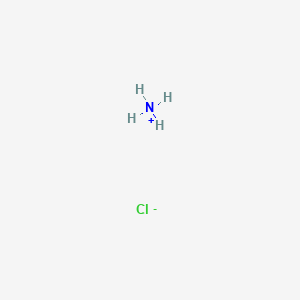
Formula: NH₄Cl — Sal ammoniac, salmiac
Molar mass: 53.49 g/mol
Appearance: White crystalline solid with slight ammonia odor
Hazard: Harmful · Irritant
Summary
White crystalline solid with a slight ammonia odor. Unlike most salts, dissolves with significant cooling effect. Sublimates when heated (solid directly to gas). Used in cold packs, soldering flux, and as a nitrogen source. The ammonium ion can release ammonia in basic conditions, linking it to ammonia chemistry.
History
Ammonium chloride has an ancient pedigree. The name “sal ammoniac” derives from the Temple of Ammon (Jupiter Ammon) in the Libyan desert, near the Siwa Oasis, where it was first found crystallizing from camel dung. Egyptian priests reportedly collected it from temple walls where it formed from burning camel dung fuel.
For centuries, sal ammoniac was essential to metalworking. Blacksmiths and tinsmiths used it as a flux because it cleans metal surfaces and enables solder to flow. The alchemist Geber (Jabir ibn Hayyan) described its preparation in the 8th century.
The unusual endothermic dissolution was noticed early - medieval texts mention using sal ammoniac to cool beverages. Modern “instant cold packs” exploit this same property, with ammonium chloride or ammonium nitrate providing the chill when mixed with water.
How to get it
Ammonium chloride forms whenever ammonia and hydrochloric acid meet in the gas phase — even waving an open bottle of household ammonia near a bottle of muriatic acid produces a wisp of white “smoke” as the two gases combine instantly: NH₃ + HCl → NH₄Cl. A purer sample can be made by carefully mixing measured amounts of household ammonia solution and dilute hydrochloric acid, then evaporating the resulting solution to dryness on low heat. The white solid that remains is ammonium chloride, and the process can be reversed by gentle heating, which sublimates the salt directly back into gas — a complete cycle in a single afternoon.
Experiments
Endothermic Dissolution: Dissolve in water and feel the container get cold - this is an endothermic reaction that absorbs heat from surroundings. Use a thermometer to measure the temperature drop, demonstrating energy changes in chemical reactions.
Smoke Generation: When heated, NH₄Cl sublimates (turns directly from solid to gas) and then condenses as white “smoke” - actually tiny solid particles. This demonstrates phase changes and is used in smoke effects. Can also react with sodium nitrite to produce nitrogen gas.
Experiments using this chemical:
- Hot and Cold Packs - Endothermic dissolution
- Crystal Growing - Feathery crystals from vapor (sublimation)
Safety
Moderate hazard — irritant; avoid heating.
First aid: rinse skin and eyes with water; if swallowed, rinse the mouth and drink water.
Incompatible with: Strong oxidisers; strong bases (releases ammonia gas); lead and silver salts; potassium chlorate (potentially explosive mixture when heated)
Disposal: dilute and flush down the drain; lab quantities are not environmentally significant.