Calcium Carbonate
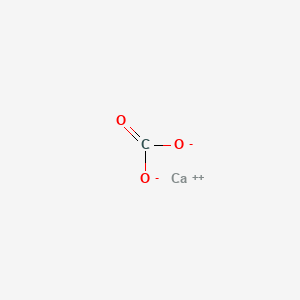
Formula: CaCO₃ — Chalk, calcite, limestone, marble, precipitated calcium carbonate, antacid
Molar mass: 100.09 g/mol
Appearance: White powder or solid (chalk, marble chips)
Hazard: Not classified as hazardous
Summary
White solid, slightly soluble in pure water (0.0013 g/100 mL) but readily dissolves in acid with vigorous CO₂ evolution. Exists in three crystalline forms: calcite (most stable, rhombohedral), aragonite (found in shells and pearls), and vaterite (rare, unstable). Thermally decomposes above ~840°C to calcium oxide (quicklime) and CO₂ — the lime-burning process that has been used in construction for thousands of years. In slightly acidic conditions (dissolved CO₂ in rainwater), CaCO₃ converts to soluble calcium bicarbonate, Ca(HCO₃)₂ — the chemistry behind cave formation and hard water.
History
Calcium carbonate is the geological backbone of vast areas of the Earth’s surface. Limestone and chalk are formed from the compacted shells and skeletons of ancient marine organisms — the White Cliffs of Dover are pure calcium carbonate, accumulated over 70 million years by microscopic single-celled algae called coccolithophores. The Great Pyramid of Giza and the Colosseum were both built from limestone; the Parthenon and Michelangelo’s sculptures from marble (metamorphic limestone).
The lime cycle — limestone → quicklime (by burning) → slaked lime (by adding water) → calcium carbonate again (by absorbing atmospheric CO₂) — has been exploited for at least 10,000 years. Roman concrete used a hydraulic lime that hardened even underwater, giving aqueducts and harbor walls a strength that puzzled engineers for centuries.
Chalk (a form of CaCO₃) gave its name to entire geological periods: the Cretaceous era takes its name from creta, Latin for chalk. The same compound makes up eggshells, oyster shells, coral reefs, and antacid tablets (Tums). Its reaction with stomach acid — identical to chalk dissolving in vinegar — is the basis of antacid chemistry.
How to get it
Pure calcium carbonate is easily precipitated from two solutions available in any chemistry kit. Dissolve calcium chloride in water, then add sodium carbonate solution — a white precipitate of calcium carbonate forms immediately: CaCl₂ + Na₂CO₃ → CaCO₃ + 2NaCl. Filter, rinse, and dry the precipitate to obtain a fine white powder identical to precipitated chalk. This reaction also demonstrates that CO₂ from the air slowly converts a calcium hydroxide (limewater) solution to calcium carbonate over time, which is why limewater goes cloudy when exposed to air.
Experiments
CO₂ Generator: Place chalk, marble chips, or crushed eggshell in a container and add vinegar (or dilute hydrochloric acid). Vigorous fizzing produces CO₂:
\[\ce{CaCO3(s) + 2CH3COOH(aq) -> Ca(CH3COO)2(aq) + H2O(l) + CO2(g)}\]
Collect the CO₂ with an upturned jar and use it in the CO₂ Density Demo or the Limewater CO₂ Test.
Naked Egg: Submerge an egg in white vinegar for 24–48 hours. The shell (CaCO₃) dissolves completely, leaving the rubbery membrane intact. The egg may swell as water osmoses through the unprotected membrane. Demonstrates acid dissolution, osmosis, and membrane biology.
Limescale: Boil hard tap water repeatedly in a saucepan. White calcium carbonate scale deposits on the base. Add vinegar to dissolve it — the scale fizzes and disappears. This is the chemistry of kettle descalers. Connects to Water Softening.
Experiments using this chemical:
- Limewater CO₂ Test — CaCO₃ is both a CO₂ source (with acid) and the precipitate product of the test
- CO₂ Density Demo — Generate CO₂ from chalk or eggshell and acid
- Water Softening — Limescale formation and removal
Safety
Very low hazard — food-grade (antacid tablets are pure CaCO₃).
First aid: none needed; rinse eyes with water if dust gets in them.
Incompatible with: Strong acids (vigorous CO₂ evolution — avoid sealed containers, pressure can build rapidly); fluorine; high heat above 840°C (thermal decomposition produces caustic CaO)
Disposal: completely harmless — bin the solid or flush dilute suspensions down the drain.