Calcium Chloride
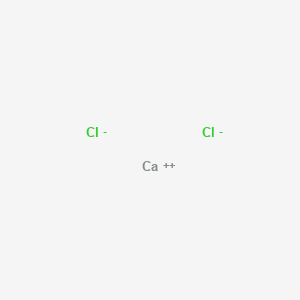
Formula: CaCl₂ — Calcium chloride, road salt, desiccant
Molar mass: 110.98 (anhydrous) g/mol
Appearance: White hygroscopic solid (pellets or flakes)
Hazard: Irritant
Summary
White hygroscopic solid that readily absorbs moisture from air. Highly soluble in water with significant heat release. Used as a desiccant, de-icer, and in food processing. The calcium ions are essential for spherification with alginate. Related to other calcium salts but much more soluble than calcium carbonate or sulfate.
History
Calcium chloride was first produced as a waste product of the Solvay process for making sodium carbonate, patented by Ernest Solvay1 in 1861. For decades, manufacturers struggled to find uses for the massive quantities produced.
The compound found its calling in winter road maintenance. In 1917, during World War I, calcium chloride was first used to control dust on unpaved roads. Its hygroscopic nature proved valuable - it absorbs moisture from the air to keep roads damp. Later, its ability to lower the freezing point of water made it essential for de-icing. The dramatic heat release when dissolved in water was exploited in early “instant hot packs” developed in the 1970s.
Experiments
Exothermic Dissolution: Dissolves in water with intense heat release - can make a hot pack by sealing CaCl₂ and water in separate compartments. Demonstrates exothermic reactions dramatically. Measure temperature increases of 20-30°C or more!
Reverse Spherification: Use with sodium alginate for “reverse spherification” where the calcium is inside the sphere. Creates gels with liquid centers. Also useful for making firm spheres that can be rinsed, unlike forward spherification with external calcium bath.
Experiments using this chemical:
- Hot and Cold Packs - Exothermic dissolution
- Gravimetric Humidity - Weigh the water vapour in air as a desiccant
- Spherification - Gel sphere formation
- Chemical Garden - White silicate growths
- Flame Tests - Orange-red flame color
- Food Chemistry: Spherification - Molecular gastronomy
- Ferrofluid Synthesis - Desiccant for drying the magnetite (advanced route)
How to get it
Calcium chloride is sold in several everyday contexts:
- Ice melt: Hardware stores carry it as “calcium chloride ice melt” (e.g., Dow Peladow or similar). This is typically 94–97% pure and works for most experiments.
- Food grade: Available online as a food additive (E509) — use this for spherification and any food-safe application.
- DampRid: The white crystals in humidity absorbers are calcium chloride — in a pinch, these can be used, though they may contain additives.
For spherification, buy food-grade calcium chloride specifically. Search “calcium chloride food grade” online.
Safety
Moderate hazard — exothermic dissolution; irritant.
First aid: rinse skin and eyes with plenty of water; if swallowed, rinse the mouth and drink water.
Incompatible with: Water (extremely exothermic dissolution — add slowly and stir); strong bases; borate compounds; zinc metal; bromine trifluoride
Disposal: dilute well and flush down the drain — it is used as road salt and is not environmentally significant in small amounts.
Footnotes
Ernest Solvay — Belgian chemist (1838–1922) whose ammonia-soda process replaced the Leblanc process for soda ash.↩︎