Calcium Hydroxide
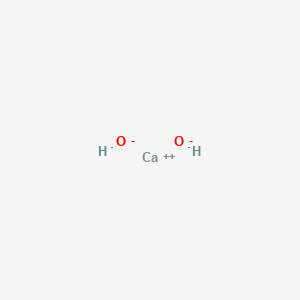
Formula: Ca(OH)₂ — Slaked lime, pickling lime, hydrated lime
Molar mass: 74.09 g/mol
Appearance: White powder
Hazard: Irritant · Corrosive
Summary
White powder, slightly soluble in water (the solution is called limewater). Strong base but safer to handle than sodium hydroxide. Made by adding water to quicklime (calcium oxide). Used in construction (mortar), food processing (nixtamalization of corn), and water treatment. Absorbs CO₂ from air over time, converting back to calcium carbonate.
History
The lime cycle - limestone to quicklime to slaked lime and back - has been known for at least 12,000 years. Ancient buildings at Göbekli Tepe (9000 BCE) used lime mortar. The chemistry involves burning limestone (Cite: CaCO₃ → CaO + CO₂), adding water (CaO + H₂O → Ca(OH)₂), and allowing the hydroxide to absorb atmospheric CO₂ and harden back to calcium carbonate.
Limewater’s ability to turn cloudy white with carbon dioxide was noted by Joseph Black1 in 1756, leading to his discovery of “fixed air” (carbon dioxide) - one of the first demonstrations that gases were distinct substances. This observation helped overturn phlogiston theory and establish modern chemistry.
The lime cycle remains essential to construction. Portland cement, concrete, and mortar all rely on the carbonation reaction. In agriculture, slaked lime raises soil pH and provides calcium. In food processing, it’s used for nixtamalization - the ancient Mesoamerican process that makes corn more nutritious and easier to grind for tortillas.
Experiments
CO₂ Detection: Mix with water to make limewater - it turns cloudy white when CO₂ is bubbled through it, forming calcium carbonate. Perfect for testing exhaled breath or combustion products. This demonstrates gas detection and precipitation reactions.
pH Indicator: Strong base (pH ~12.4) useful for demonstrating acid-base neutralization. Mix with phenolphthalein indicator and watch the pink color disappear as you add acid. Can also be used to show the pH scale with universal indicator.
Experiments using this chemical:
- Limewater CO₂ Test - Detect CO₂ in breath
How to get it
Calcium hydroxide (slaked lime) is available under several names:
- Grocery store: sold as pickling lime (e.g., Mrs. Wages brand) in the canning section. Food-grade and perfectly suitable for making limewater.
- Garden center: sold as hydrated lime or garden lime — usually pure enough for experiments, though less controlled than food-grade.
- Hardware / masonry suppliers: “finishing lime” or “mason’s lime” — also calcium hydroxide, but check it’s not mixed with sand.
For limewater experiments, the pickling lime from grocery stores is ideal: food-safe, inexpensive, and reliably pure.
Buy online:
Amazon: Pure Calcium Hydroxide (Slaked Lime) — Non-GMO, Gluten-Free, 400g/14oz affiliate
Safety
Moderate hazard — corrosive; strongly alkaline.
First aid: flush skin and eyes with plenty of water for 15 minutes and seek medical care for eye contact. If swallowed, rinse the mouth and drink water; do not induce vomiting.
Incompatible with: Strong acids (vigorous exothermic neutralisation); ammonium salts (releases ammonia gas); CO₂ in air (slow conversion to calcium carbonate); maleic anhydride
Disposal: neutralize with dilute acid or vinegar, then dilute and flush down the drain.
Footnotes
Joseph Black — Scottish chemist (1728–1799) who discovered carbon dioxide (‘fixed air’).↩︎