Copper
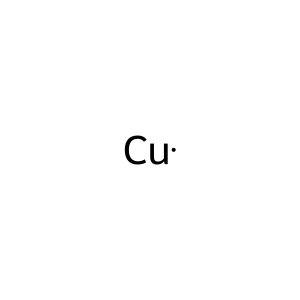
Formula: Cu — Copper, cuprum
Molar mass: 63.55 g/mol
Appearance: Reddish-brown lustrous metal
Hazard: Low hazard (solid) · Environmental hazard in solution
Summary
Excellent electrical and thermal conductor. Density 8.96 g/cm³, melting point 1085°C. Resists dilute acids but dissolves in concentrated acids and oxidizing acids. Slowly oxidizes in moist air to form a green patina (basic copper carbonate, verdigris). Available as wire, sheet, strip, or coins. The basis of bronze (Cu + Sn) and brass (Cu + Zn) alloys.
History
One of the first metals worked by humans — the Copper Age preceded the Bronze Age around 5000 BCE. The name “copper” derives from Kypros (Cyprus), where the Romans obtained much of their supply. Copper’s electrical conductivity made it essential to the electrical revolution of the 19th century; today, roughly two-thirds of all copper produced goes into electrical applications.
In chemistry, copper’s two stable oxidation states (Cu⁺ and Cu²⁺) and their dramatically different colors made it a central subject of early coordination chemistry. Alfred Werner’s Nobel Prize-winning work on coordination compounds drew heavily on copper complexes.
Experiments
Displacement Reaction: Drop copper wire into silver nitrate solution — silver crystals grow on the copper as it dissolves. A vivid demonstration of the activity series and displacement reactions.
Artificial Patina: Hold copper sheet over ammonia fumes above dilute acetic acid — blue-green verdigris (basic copper carbonate) forms within minutes, mimicking centuries of weathering.
Experiments using this chemical:
- The Many Colors of Copper - Starting point for the full copper compound series
- Copper Reduction - Copper deposits from solution onto iron
- Electroplating - Copper as anode for electroplating
Safety
Solid copper is non-toxic and safe to handle. Copper compounds dissolved in water are toxic to aquatic organisms — dispose of copper-containing solutions responsibly, not down the drain.
First aid: none needed for the solid metal; clean and dress any cuts from sharp edges.
Disposal: recycle copper metal. Copper-containing solutions are toxic to aquatic life — precipitate and collect the copper rather than draining it.