Cream of Tartar
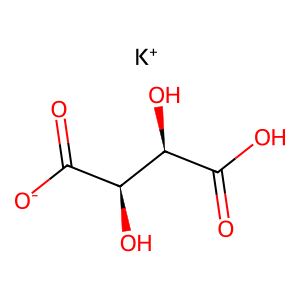
Formula: KHC₄H₄O₆ — Potassium hydrogen tartrate (potassium bitartrate)
Molar mass: 188.18 g/mol
Appearance: White fine crystalline powder
Hazard: Not classified as hazardous
Summary
Cream of tartar is the potassium acid salt of tartaric acid — one proton of the tartaric acid molecule has been replaced by potassium, leaving the other as a free acid. It is moderately acidic (pH ~3.5 in solution) and only sparingly soluble in cold water (~5 g/100 mL at 20°C), which is why it precipitates from wine during fermentation as hard crystals on the inside of barrels.
On heating it decomposes before melting. In baking, it reacts with baking soda (an acid–base reaction) to release CO₂ and is the active acid component of most baking powder formulations.
History
Cream of tartar has been deposited in wine barrels since antiquity. The crystalline sediment (argol or wine stone) was collected, purified, and sold by medieval apothecaries and glassmakers, who used it in dye mordanting, soldering fluxes, and medicine. The purified potassium bitartrate was called crème de tartre in French — hence the English name.
Its chemical identity was clarified in the early 19th century. Louis Pasteur1’s 1848 discovery of molecular chirality used tartaric acid crystals derived from cream of tartar — he showed that racemic tartaric acid could be mechanically separated into two mirror-image crystal forms that rotated polarised light in opposite directions, a landmark in stereochemistry.
How to get it
Available in any supermarket, sold in small tins or sachets in the baking aisle. Laboratory-grade potassium hydrogen tartrate is also available from chemical suppliers if higher purity is needed, but food-grade cream of tartar works for all experiments here.
Experiments
Synthesis of Rochelle Salt: Reacting cream of tartar with baking soda produces Rochelle salt (sodium potassium tartrate), which forms large piezoelectric crystals:
\[\ce{KHC4H4O6 + NaHCO3 -> NaKC4H4O6 + H2O + CO2 ^}\]
Acid–Base Reaction with Baking Soda: A pinch of cream of tartar mixed with a pinch of baking soda in water produces brisk CO₂ effervescence — the same reaction that makes baked goods rise. This is a clean, food-safe way to demonstrate acid–base chemistry.
Experiments using this chemical:
- Rochelle Salt — Crystal Growing and Piezoelectric Microphone — Synthesis, crystal growing, and piezoelectricity
Safety
Food-safe; used as a cooking ingredient worldwide. No special precautions required.
First aid: none needed; rinse eyes with water if powder gets in them.
Incompatible with: Strong bases (neutralisation reaction, releases tartrate); reacts with baking soda to release CO₂.
Disposal: harmless — rinse down the drain.
Footnotes
Louis Pasteur — French chemist (1822–1895) who discovered molecular chirality by separating tartrate crystals by hand.↩︎