Cupric Chloride
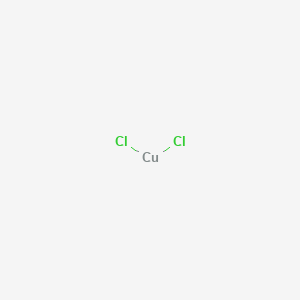
Formula: CuCl₂·2H₂O — Copper(II) chloride dihydrate
Molar mass: 134.45 (anhydrous) g/mol
Appearance: Blue-green crystalline solid
Hazard: Harmful · Irritant · Environmental hazard
Summary
Blue-green crystalline solid. The color differs from copper sulfate due to different coordination geometry and the chloride ligands. Highly soluble in water. Used in electroplating, pyrotechnics (blue-green flame color), and as a catalyst. Can be reduced to cuprous chloride (CuCl) or copper metal.
History
Copper chlorides have been known since antiquity, forming in nature where copper ores meet sea spray or volcanic vapors. The mineral atacamite (basic copper chloride) was used as a pigment by ancient Egyptians and Mayans for its distinctive green color.
The stunning blue-green flame color of copper chloride made it a favorite of pyrotechnicians. Chinese fireworks masters discovered that copper salts produced beautiful colors, and cupric chloride became essential for blue and green pyrotechnic effects. The intense color arises from electronic transitions in copper atoms excited by the flame’s heat.
The compound also demonstrates interesting coordination chemistry. In solution, the copper ion coordinates with water molecules (blue) or chloride ions (green), and the equilibrium between these forms can be shifted by temperature or concentration, causing visible color changes.
How to get it
Cupric chloride is readily prepared from copper metal and hydrochloric acid — with a small assist from an oxidizer, since copper alone does not dissolve in HCl. Place copper wire or a copper coin in dilute hydrochloric acid and add a few drops of hydrogen peroxide; the peroxide oxidizes the copper to Cu²⁺ while the chloride provides the anion, and the solution turns blue-green as cupric chloride forms. Evaporate gently to concentrate, and the blue-green crystalline solid will appear as the water drives off. Alternatively, dissolving copper in a mixture of hydrochloric acid and a small amount of sodium nitrate works by the same principle, as the nitrate acts as the oxidant.
Experiments
Flame Color: Produces a striking blue-green flame color when heated. Demonstrates atomic emission and is used in pyrotechnics. Dip a wooden splint in solution, let dry, then burn to see the color.
Copper Electrochemistry: Use as electrolyte for copper plating with better throwing power than sulfate solutions. Can also demonstrate the oxidation states of copper by reducing to Cu⁺ or Cu metal.
Oscillating Reactions: Component in some oscillating chemical reactions. Can participate in redox cycles that produce color changes.
Experiments using this chemical:
- The Many Colors of Copper - Blue-green teal contrast with copper sulfate
- Crystal Growing - Blue-green hygroscopic crystals
- Chemical Garden - Blue-green silicate growths
- Flame Tests - Blue-green flame color
Safety
Moderate hazard — harmful; toxic to aquatic life.
First aid: rinse skin and eyes with water; if swallowed, rinse the mouth, drink water, and seek medical advice.
Incompatible with: Strong bases; reactive metals (aluminium, zinc, magnesium — displacement reactions); strong oxidisers; alkali metals
Disposal: toxic to aquatic life — precipitate the copper with washing soda, collect the solid for hazardous-waste, then flush the clear liquid.