Ferric Ammonium Citrate
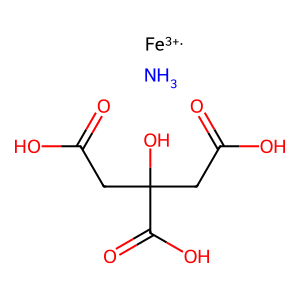
Formula: variable — a complex of Fe³⁺, ammonium, and citrate (roughly C₆H₈O₇·xFe·yNH₃)
Molar mass: variable (mixture)
Appearance: Green or brown flakes/granules (two commercial grades)
Hazard: Low hazard
Summary
A light-sensitive iron(III) salt sold as green or brown flakes. Under ultraviolet light its Fe³⁺ is reduced to Fe²⁺, which then reacts with ferricyanide to form insoluble Prussian blue — the chemistry behind the cyanotype (blueprint) process. The “green” grade is more light-sensitive and is preferred for photographic printing.
History
John Herschel1 invented the cyanotype in 1842 using iron salts and ferricyanide, giving the world its first easily reproduced photographic blueprint. Anna Atkins2 used the process to produce Photographs of British Algae (1843), often called the first book illustrated with photographic images. Ferric ammonium citrate remains the light-sensitive half of the classic cyanotype sensitiser.
Experiments
Cyanotype: Painted onto paper with potassium ferricyanide and exposed to sunlight, the citrate’s Fe³⁺ is photo-reduced to Fe²⁺, which forms Prussian blue where the light struck — a permanent blue image after a water wash.
Experiments using this chemical:
- Cyanotype Photogram - Light-sensitive iron half of the sensitiser
Safety
Low hazard — mild irritant; used historically as an iron dietary supplement.
First aid: rinse skin and eyes with water.
Incompatible with: Strong oxidisers; strong bases (iron hydroxide precipitation).
Disposal: small quantities can be flushed with plenty of water; precipitate larger amounts with washing soda and bin the solid.
Footnotes
John Herschel — English polymath (1792–1871) who invented the cyanotype photographic process in 1842.↩︎
Anna Atkins — English botanist and photographer (1799–1871) who made the first book illustrated with photographs, using cyanotypes of algae.↩︎