Gallium
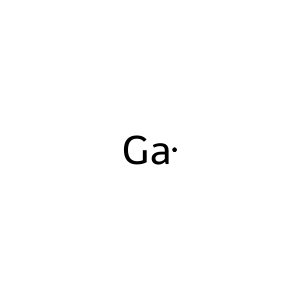
Formula: Ga — Gallium
Molar mass: 69.72 g/mol
Appearance: Silvery, soft metal; melts to a mirror-bright liquid
Hazard: Low toxicity · Attacks aluminum & other metals
Summary
Gallium is a soft, silvery metal with a remarkably low melting point of 29.76 °C — below human body temperature, so a lump held in the palm slowly slumps into a bright liquid puddle. It stays molten over an enormous range, not boiling until 2400 °C, one of the largest liquid ranges of any element. Like water, it expands on freezing (by about 3 %), so it must never be stored in a sealed glass container.
Solid gallium is safe to handle with clean, dry hands and is far less toxic than mercury — the liquid metal it most resembles. Its defining laboratory hazard is chemical, not toxic: molten gallium readily wets and diffuses into aluminum, embrittling it from within, and alloys with many other metals, so it should be kept well away from aluminum foil, cookware, jewelry, and drink cans.
History
Gallium is a small triumph of the periodic table. In 1871 Dmitri Mendeleev predicted an undiscovered element below aluminum, which he called eka-aluminium, and estimated its properties. Four years later the French chemist Paul-Émile Lecoq de Boisbaudran isolated it from a zinc ore by spectroscopy and named it gallium after Gallia (France) — the predicted and measured properties matched almost exactly, a striking early confirmation of Mendeleev’s scheme.
For decades gallium was a curiosity. Today it is an industrial workhorse: gallium arsenide (GaAs) and gallium nitride (GaN) are the semiconductors behind LEDs, laser diodes, fast RF chips, and efficient phone chargers. Gallium is not mined directly but recovered as a by-product of aluminum and zinc refining.
How to get it
Gallium is sold cheaply by hobby-chemistry and metal suppliers as small ingots, usually 99.99 % pure, in plastic vials (never sealed glass, because of freezing expansion). It is one of the few elements a beginner can buy, melt, and re-melt indefinitely at kitchen temperatures. To melt it, stand the vial in a cup of warm (~40 °C) water rather than heating it directly.
Experiments
The metal that melts in your hand: Warm a gram or two of gallium in warm water or a cupped palm and watch it collapse into a mirror-bright liquid at just under 30 °C. Pour it back into a mold and it re-solidifies as it cools — endlessly reusable.
Aluminum embrittlement: A drop of molten gallium smeared onto scratched aluminum foil or a soda can soaks into the grain boundaries and destroys the metal’s strength; the aluminum can then be torn or crumbled like paper. A dramatic illustration of grain-boundary structure and liquid-metal embrittlement. This permanently ruins the aluminum — do it only on scrap.
Casting & the “spoon” trick: Cast gallium in a silicone mold of a spoon; stirring hot tea makes the spoon vanish. Because gallium expands on freezing it also captures fine mold detail.
Experiments using this chemical:
- Gallium: The Metal That Melts in Your Hand - Low-melting metals and liquid-metal embrittlement
Safety
Gallium is low in toxicity and safe to handle briefly with clean, dry hands; wash afterwards and avoid ingestion. The real hazard is to other metals.
First aid: wash it off the skin with soap and water; rinse eyes if grains get in them. Essentially non-toxic on brief contact.
Incompatible with: Aluminum (embrittles it), and most other metals — steel, copper, and jewelry — which it alloys or stains. Keep off rings and phones. Do not store in sealed glass, which it can crack by expanding as it freezes.
Disposal: reusable indefinitely — keep it. Do not bin loose liquid gallium; solidify it in a sealed plastic container first.