Indigo Carmine
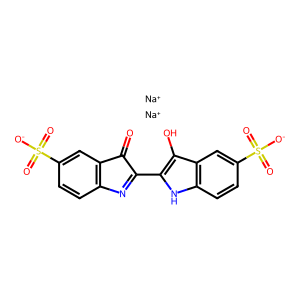
Formula: C₁₆H₈N₂Na₂O₈S₂ — Indigotine, FD&C Blue No. 2, E132
Appearance: Deep blue powder; highly soluble in water
Hazard: Approved food dye · Stains skin and surfaces
Properties
Water-soluble sulfonated derivative of indigo. Unlike indigo powder, which is insoluble, the two sulfonate groups make indigo carmine freely soluble in water. A redox indicator: the oxidized form is blue, the fully reduced form (leucoindigo carmine) is yellow, and a partial reduction intermediate is red-orange. The reduction endpoint depends on conditions; cycling between states is reversible. Used as a food dye (blue M&Ms, grape and berry products), in kidney function medical testing, and in analytical chemistry.
Historical Context
Indigo carmine was developed in the mid-19th century as a water-soluble alternative to indigo for dyeing and analytical use. Its approval as a food dye (FD&C Blue #2) dates to the early 20th century. The “chameleon reaction” using indigo carmine in glucose and NaOH was popularized as a chemistry demonstration in the 1990s for its striking color progression and repeatability.
Experiments
Stoplight Reaction: Dissolve in water with sodium hydroxide and glucose. The glucose reduces the dye to yellow. Shake the sealed bottle: yellow → red → green → blue as oxygen reoxidizes it. Set it down and watch it reverse. Cycles 10–15 times on a single batch — more colors and more cycles than the methylene blue Blue Bottle.
Comparison with Indigo Powder: Both share the indigoid core structure, but indigo carmine is water-soluble due to the sulfonate groups, while indigo powder requires chemical reduction (a dye vat) to dissolve. Side-by-side comparison demonstrates how functional groups change physical properties.
Experiments using this chemical:
- Stoplight Reaction - Four-color redox cycle: yellow → red → green → blue
Safety
Non-toxic at experimental concentrations — approved as a food additive. May stain skin, fabrics, and bench surfaces blue. Stains typically wash off with soap and water. Handle sodium hydroxide used in the stoplight reaction with normal care (gloves, eye protection).