Lithium Chloride
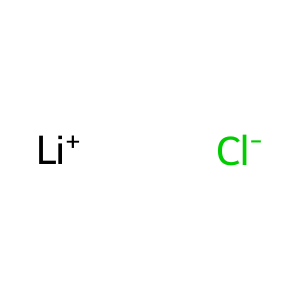
Formula: LiCl — Lithium chloride
Molar mass: 42.39 g/mol
Appearance: White crystalline solid (strongly hygroscopic)
Hazard: Harmful · Irritant
Summary
White, strongly hygroscopic1 solid that draws water from the air. Best known for the intense crimson it lends to a flame — the classic test colour for lithium. Lithium salts are pharmacologically active (lithium is used to treat bipolar disorder), so LiCl is genuinely harmful if swallowed and is the least household-obtainable of the common flame-test salts.
History
Lithium was discovered in 1817 by Johann August Arfwedson in the mineral petalite, and named from the Greek lithos (“stone”) because it was found in rock rather than plant ash like sodium and potassium. Its crimson flame made it easy to recognise once flame spectroscopy matured under Robert Bunsen2 and Gustav Kirchhoff3.
Lithium chloride has served as a powerful desiccant and, briefly and disastrously, as a 1940s salt substitute — withdrawn when patients on low-sodium diets were poisoned by uncontrolled lithium doses, a reminder that “like table salt” chemistry can be anything but.
Experiments
Flame Test: Lithium chloride burns a deep crimson red — deeper than strontium is often claimed, though the two are close. A staple of the flame-test colour series.
Experiments using this chemical:
- Flame Tests - Crimson-red flame color
Safety
Moderate hazard — harmful if swallowed; lithium is biologically active.
First aid: rinse skin and eyes with water; if swallowed, rinse the mouth, drink water, and seek medical advice.
Incompatible with: Strong oxidisers; strong acids (HCl release).
Disposal: small flame-test quantities are dilute — flush with plenty of water.
Footnotes
Hygroscopic — Readily absorbing moisture from the air.↩︎
Robert Bunsen — German chemist (1811–1899) who, with Kirchhoff, developed flame spectroscopy and the Bunsen burner.↩︎
Gustav Kirchhoff — German physicist (1824–1887) who co-founded spectroscopy with Bunsen.↩︎