Magnesium Hydroxide
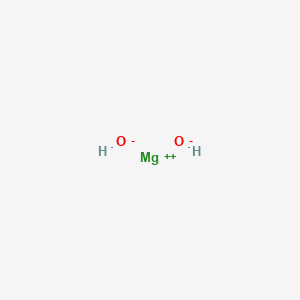
Formula: Mg(OH)₂ — Milk of magnesia, magnesium hydrate
Molar mass: 58.32 g/mol
Appearance: White powder or milky suspension
Hazard: Not classified as hazardous at typical concentrations
Summary
White powder that forms a milky suspension in water (hence “milk of magnesia”). Only slightly soluble in water, but the small amount that dissolves creates a basic solution (pH ~10). Used as an antacid and laxative. The suspension scatters light, appearing white. Neutralizes acids to form soluble magnesium salts.
History
Sir James Murray of Belfast invented milk of magnesia in 1829 as a treatment for stomach ailments. He found that suspending finely divided magnesium hydroxide in water created an effective, mild antacid that was gentler than the caustic lime-based remedies of the time.
Charles Henry Phillips, an English pharmacist who emigrated to America, commercialized the product in 1880 as “Phillips’ Milk of Magnesia.” His marketing genius made it a household name that persists today, over 140 years later.
The chemistry is elegant: magnesium hydroxide is basic enough to neutralize stomach acid, but insoluble enough that it doesn’t damage tissue. It works slowly as a “buffer” - only dissolving as needed when acid is present. This makes it safer than soluble bases like sodium hydroxide.
The laxative effect comes from the magnesium ion. Poorly absorbed in the intestine, it draws water by osmosis, softening stool. This dual antacid/laxative action made milk of magnesia a medicine cabinet staple for generations.
Experiments
Rainbow Neutralization: Add universal indicator to milk of magnesia suspension, then slowly add vinegar. Watch the colors change from blue/green (basic) through the rainbow to orange/red (acidic) as the base neutralizes. The milky suspension clears as insoluble Mg(OH)₂ converts to soluble magnesium acetate.
Antacid Comparison: Compare different antacids (milk of magnesia, Tums, baking soda) by seeing how much acid each can neutralize. Demonstrates stoichiometry and buffering capacity.
Suspension vs. Solution: Compare milk of magnesia (suspension - particles settle, scatters light) with salt water (true solution - clear, doesn’t settle). Demonstrates colloidal chemistry.
Experiments using this chemical:
- Milk of Magnesia Rainbow - Color-changing neutralization
- Rainbow pH Indicator - Basic end of pH scale
How to get it
- Pharmacy: Sold as “Milk of Magnesia” (get unflavored for experiments)
- Concentration: Typically 400mg Mg(OH)₂ per 5mL (8% suspension)
- Form: Pre-made suspension is most convenient; powder available from chemical suppliers
Making it yourself
Magnesium hydroxide precipitates instantly when any soluble magnesium salt meets a strong base. Dissolve Epsom salt (magnesium sulfate) in water, then add sodium hydroxide solution — a white, milky precipitate of Mg(OH)₂ forms immediately: MgSO₄ + 2NaOH → Mg(OH)₂ + Na₂SO₄. Filter and wash the precipitate with water to remove sodium sulfate, then suspend the white solid in a small amount of water to produce a homemade milk of magnesia. The suspension behaves identically to the pharmacy product for indicator and neutralization experiments.
Safety
Very low hazard — food and pharmaceutical use.
First aid: none needed — it is milk of magnesia; rinse eyes with water if needed.
Incompatible with: Strong acids (vigorous neutralisation, heat release); maleic anhydride; sulfur in heated mixtures; phosphorus
Disposal: harmless — flush down the drain or bin the solid.