Menthol
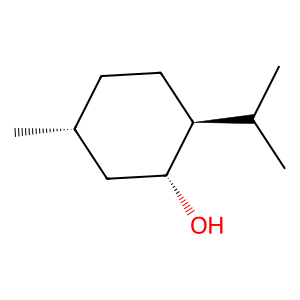
Formula: C₁₀H₂₀O — (1R,2S,5R)-2-isopropyl-5-methylcyclohexan-1-ol
Molar mass: 156.27 g/mol
Appearance: Colorless waxy crystalline solid with strong peppermint odor
Hazard: Low hazard — food and cosmetic grade
Summary
Waxy crystalline solid at room temperature, melting at 42–43°C (l-menthol). Strongly aromatic — the characteristic scent of peppermint. Barely soluble in water (0.5 g/100 mL at 20°C) but dissolves freely in ethanol, oils, and most organic solvents. Sublimates slowly at room temperature; warm gently and it vapourises readily, condensing on cool surfaces as delicate feathery crystals.
The cooling sensation is not a drop in temperature — menthol activates TRPM8, a cold-sensitive ion channel in nerve cells, tricking the nervous system into registering cold without any actual temperature change. This makes it uniquely useful in food, cosmetics, and topical pain relief.
Occurs naturally as the l-form ((-)-menthol), the most abundant and potent isomer, found in peppermint (Mentha × piperita) and corn mint (Mentha arvensis). The racemic dl-form, synthesised industrially, has a slightly lower melting point (34–35°C) and weaker cooling effect.
History
Menthol was isolated from peppermint oil in Japan in the late 18th century and formally characterised by European chemists in the 1840s. The German chemist Friedrich Strecker named and described it in 1861. For most of the 19th century it was extracted laboriously from peppermint oil — world demand for “Japan menthol” from Mentha arvensis cultivation in Okayama and Hokkaido drove a major agricultural industry.
Industrial synthesis followed in the 20th century. The most elegant route is Haarmann & Reimer’s synthesis from thymol (1904) — a five-step sequence that became commercially important. Today about 30,000 tonnes of menthol are produced annually; roughly 70% is still natural, extracted from corn mint grown in India and China.
The TRPM8 receptor, the molecular target of menthol, was only identified in 2002 — so for over a century, the cooling sensation was described empirically without understanding its mechanism. TRPM8 research later earned its discoverers a share of the 2021 Nobel Prize in Physiology or Medicine (alongside capsaicin/TRPV1 work).
How to get it
Sold as “menthol crystals” in herb shops, soap-making suppliers, and online. Food-grade is sufficient for all experiments; look for ≥99% l-menthol. A small 50 g bag is enough for years of experiments.
Experiments
Crystal Patterns from the Melt: Melt a small amount of menthol (≥43°C in a hot water bath), then pour a thin puddle on aluminium foil or a glass slide and watch dendritic crystals radiate outward as it cools. The branching patterns vary with cooling rate — slow cooling gives coarser, more regular crystals; fast cooling gives finer, more complex dendrites.
Sublimation Feathers: Place a few crystals on a piece of aluminium foil and hold a cold glass dish just above them over low heat. Menthol vapour condenses on the glass as beautiful acicular (needle-like) crystals. Demonstrates sublimation — solid → gas → solid — without ever passing through a liquid phase.
Cooling Sensation Comparison: Dissolve a tiny pinch of menthol in a few drops of ethanol. Apply a drop to one forearm and the equivalent amount of plain ethanol to the other. Both cool as the liquid evaporates, but the menthol arm registers a dramatically colder sensation — the same evaporation rate, a completely different receptor response.
Experiments using this chemical:
- Menthol Crystal Patterns — Crystallisation from the melt, dendritic growth and sublimation
- Making Sodium Metal Without Electrolysis — Menthol as the catalyst for magnesium reduction (advanced)
Safety
Low hazard — food and cosmetic grade.
Avoid inhaling concentrated vapour in an enclosed space — the intense minty odor can be irritating at high concentrations. Keep away from eyes. Do not give to infants or young children in concentrated form (menthol at high doses causes respiratory reflex in children). At the quantities used in these experiments (< 5 g) the hazard is minimal for adults.
First aid: rinse eyes with water if crystals or vapour irritate them; move to fresh air from concentrated vapour.
Incompatible with: No significant laboratory incompatibilities; flammable — keep away from open flame (flash point ~93°C)
Disposal: small amounts are harmless — bin the solid; do not wash quantities of the flammable solid down the drain.