Methylene Blue
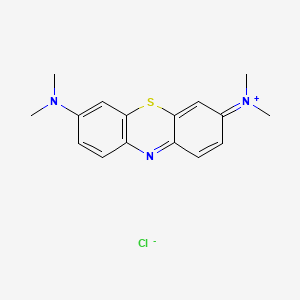
Formula: C₁₆H₁₈ClN₃S — Methylthioninium chloride
Molar mass: 319.85 (anhydrous) g/mol
Appearance: Deep blue crystalline powder
Hazard: Harmful · Oxidising agent
Summary
Deep blue crystalline powder, very soluble in water. A thiazine dye that acts as a redox indicator - blue when oxidized, colorless when reduced. Used as a biological stain, antiseptic, and in the “blue bottle” demonstration. Can cross cell membranes and stain nucleic acids. Related to other thiazine dyes; historically used to treat malaria.
History
Methylene blue was the first fully synthetic drug used in medicine. Synthesized by Heinrich Caro at BASF in 1876, it was initially used as a textile dye. Its medical career began when Paul Ehrlich discovered its remarkable property of selectively staining biological tissues while leaving others colorless.
Ehrlich’s work with methylene blue led directly to his concept of the “magic bullet” - a drug that targets specific cells. He used it to stain and study the malaria parasite, then discovered it could actually treat malaria. This was revolutionary: a synthetic chemical could cure disease. Ehrlich’s methylene blue research laid the groundwork for modern chemotherapy and earned him the 1908 Nobel Prize in Medicine.
The “blue bottle” demonstration was developed as a chemistry teaching tool in the mid-20th century. Its reversible color change perfectly illustrates oxidation-reduction reactions, and generations of students have been captivated by the seemingly magical cycle of shaking (blue) and resting (colorless).
Experiments
Blue Bottle Experiment: Create a solution with glucose and sodium hydroxide, add methylene blue. Shake to turn it blue (oxygen oxidizes the dye), then watch it turn colorless as glucose reduces it. Repeat endlessly! Demonstrates redox chemistry beautifully. Blue bottle demo
Cell Staining: Use dilute methylene blue to stain cheek cells or onion cells for microscopy. The dye binds to DNA and RNA, making nuclei visible. Demonstrates selective staining and cell structure.
Oxygen Indicator: Add to a sealed container with a reducing agent - the blue color fades as oxygen is consumed. Can be used to demonstrate anaerobic conditions or test the effectiveness of oxygen absorbers.
Experiments using this chemical:
- Blue Bottle Reaction - Reversible redox demonstration
- Traffic Light Reaction - Multi-color indicator
How to get it
Methylene blue is primarily available from aquarium supply stores, where it is sold as a fish disease treatment (ich/fin rot). The 2.303% aquarium solution works perfectly for blue bottle and traffic light experiments — dilute it further as needed.
Laboratory grade: available online as a 1% solution or as a dry powder (more economical for repeated experiments). A tiny amount goes a long way — a single bottle will last years.
Search for “methylene blue solution aquarium” or “methylene blue 1% lab grade.”
Buy online:
Amazon: Methylene Blue 1% Solution — Lab Grade Reagent, 100 mL affiliate
Safety
Moderate hazard — potent stain; drug interactions.
First aid: rinse skin and eyes with water — skin stains fade over a day or two. If swallowed, rinse the mouth and seek medical advice (note the drug-interaction warning).
Incompatible with: Strong reducing agents (reduced to colourless leuco form — the intended redox chemistry); strong oxidisers; iodides; persons taking MAO inhibitors or serotonergic drugs
Disposal: dilute heavily and flush down the drain; the quantities used as an indicator are minimal.