Potassium Chloride
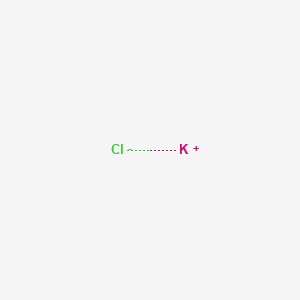
Formula: KCl — Muriate of potash, sylvite
Molar mass: 74.55 g/mol
Appearance: White crystalline solid
Hazard: Not classified as hazardous at typical quantities
Summary
White crystalline solid, very similar to table salt in appearance. Essential plant nutrient and used as a salt substitute. Isomorphous with NaCl (same crystal structure). Distinguished from NaCl by its lilac flame test. Slightly more soluble than NaCl.
History
Potassium chloride’s story is intertwined with agriculture and medicine. The mineral sylvite was named after the Dutch chemist Franciscus Sylvius in 1832. Large deposits were discovered in Stassfurt, Germany in 1856 during salt mining, revolutionizing agriculture as the first major source of potash fertilizer.
The lilac flame test for potassium was one of the earliest spectroscopic identifications, described by Robert Bunsen1 and Gustav Kirchhoff2 in 1860. Their work on flame spectroscopy led to the discovery of cesium and rubidium. Today, potassium chloride serves as a sodium-free salt substitute for those with hypertension, and in higher doses, is used in lethal injections - a stark reminder of how dose determines effect.
Experiments
Flame Test: When heated in a flame (use a wire loop), potassium compounds produce a distinctive lilac/violet color, demonstrating atomic emission spectroscopy. This shows how electrons emit specific wavelengths of light when excited. Flame test colors
Crystal Growing: Grow octahedral or cubic crystals similar to salt. KCl crystals are isomorphous with NaCl, making for interesting crystal shape comparisons when grown side-by-side.
Experiments using this chemical:
- Crystal Growing - Grow cubic crystals
- Flame Tests - Lilac/violet flame color
Safety
Low hazard — food-safe salt substitute.
First aid: none needed; rinse eyes with water if needed.
Incompatible with: Strong oxidisers; bromine trifluoride (violent); concentrated sulfuric acid with an oxidiser (HCl gas generation)
Disposal: harmless — rinse down the drain.
Footnotes
Robert Bunsen — German chemist (1811–1899) who, with Kirchhoff, developed flame spectroscopy and the Bunsen burner.↩︎
Gustav Kirchhoff — German physicist (1824–1887) who co-founded spectroscopy with Bunsen.↩︎