Potassium Nitrate
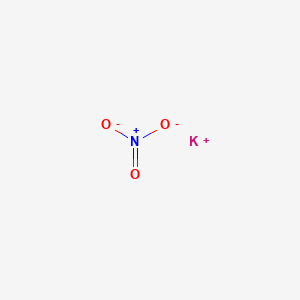
Formula: KNO₃ — Saltpeter, saltpetre, niter, nitre
Molar mass: 101.10 g/mol
Appearance: White crystalline solid
Hazard: Oxidiser · Harmful
Summary
White crystalline solid, very soluble in hot water (much less in cold). Strong oxidizer. Historically important in gunpowder and meat preservation. Forms needle-like crystals. Related to sodium nitrate but preferred for pyrotechnics due to lower hygroscopicity. The nitrate ion releases oxygen when heated.
History
Saltpeter changed the course of history. The black powder formula (75% KNO₃, 15% charcoal, 10% sulfur) emerged in China around the 9th century and reached Europe by the 13th century. For 500 years, nations desperately sought saltpeter sources - mining it from caves, importing it from India, and even collecting it from the walls of latrines and stables where nitrifying bacteria had worked.
The “Saltpeter Men” of Tudor England had legal authority to dig up stable floors and pigeon houses to collect the precious mineral. Wars were won or lost based on saltpeter supply. Napoleon’s invasion of Egypt (1798) was partly motivated by the need to secure potassium nitrate sources.
The dramatic difference in solubility between hot and cold water (247g/100mL at 100°C vs 13g/100mL at 0°C) makes potassium nitrate ideal for fractional crystallization, a technique developed by alchemists and refined over centuries. The needle-shaped crystals are among the most elegant produced by simple evaporation.
Experiments
Crystal Growing: Grow long, needle-like crystals by slow evaporation or cooling of saturated solutions. The crystals have a distinctive acicular (needle-shaped) habit that’s different from cubic salt crystals. Crystal growing techniques
Oxidizer Demonstrations: KNO₃ is a strong oxidizer - mix with sugar and heat carefully (adult supervision!) to demonstrate rapid oxidation reactions. When heated, it decomposes to release oxygen, which supports combustion. The classic “smoke bomb” chemistry demonstration.
Experiments using this chemical:
- Crystal Growing - Elegant needle-shaped crystals
- Fractional Crystallization - Separate from NaCl by cooling
How to get it
Potassium nitrate was once sold widely as saltpeter but is now harder to find in grocery stores. Current reliable sources:
- Garden supply / plant nurseries: sold as a fertilizer (“potassium nitrate” or “nitrate of potash”). Often 99%+ pure.
- Online: available from lab chemical suppliers as “potassium nitrate lab grade.” Also listed as KNO₃ or “saltpeter.”
- Pool supply: occasionally listed as an oxidizer component.
A small 100–250 g quantity is enough for flame tests and crystal growing. Store in a sealed container away from any combustible materials.
Buy online:
Amazon: Potassium Nitrate - KNO3 Powder - Laboratory Grade - 1 Pound | 1 Lb affiliate
Safety
Significant hazard — strong oxidiser; fire and explosion risk with organic materials.
First aid: rinse skin and eyes with water; if swallowed, rinse the mouth, drink water, and seek medical advice.
Incompatible with: Combustible and organic materials — wood, paper, charcoal, sulfur, metal powders: mixtures are explosive or incendiary and historically the basis of gunpowder and pyrotechnics; strong acids; reducing agents; ammonium compounds; do not grind, heat, or confine with any organic material
Disposal: dilute solutions can be flushed down the drain (it is a fertilizer); never bin the dry solid mixed with combustible rubbish.