Potassium Permanganate
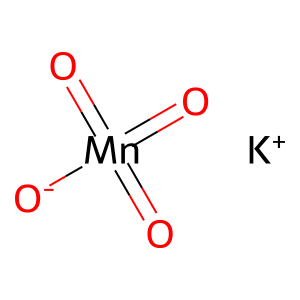
Formula: KMnO₄ — Potassium manganate(VII), Condy1’s crystals
Molar mass: 158.03 g/mol
Appearance: Deep purple-black crystals; dissolves to vivid violet solution
Hazard: Oxidizer · Irritant · Stains skin/surfaces brown
Summary
Strong oxidizing agent. Manganese sits at its highest common oxidation state (+7) in the permanganate ion. Reacts with reducing agents through stepwise reduction: Mn⁷⁺ (purple) → Mn⁶⁺ (green, strong base only) → Mn⁴⁺ (brown MnO₂ precipitate, neutral) → Mn²⁺ (colorless, acid). The endpoint of reduction depends entirely on pH. Stains skin and most surfaces brown from MnO₂; reduces immediately with ascorbic acid solution.
History
Synthesized in 1659 by Johann Rudolf Glauber2, potassium permanganate became widely used as a disinfectant and deodorizer in the 19th century under the trade name “Condy’s crystals.” Its vivid purple color and dramatic reactions with organic matter made it a mainstay of early analytical chemistry, where it was used to titrate reducing agents including oxalic acid, iron(II), and hydrogen peroxide. It remains a standard analytical reagent and is used in water treatment, wound care, and organic synthesis.
Experiments
Colors of Permanganate: Demonstrate all four Mn oxidation states in four test tubes. Acidic conditions with ascorbic acid → colorless Mn²⁺. Neutral conditions → brown MnO₂ precipitate. Alkaline conditions with NaOH + glucose → green manganate then brown. The entire redox chemistry of manganese in one session.
Chameleon Reaction: In a sealed bottle with NaOH and glucose, the solution cycles between purple, green, and brown as glucose reduces the permanganate and shaking reintroduces oxygen. Repeatable many times.
Experiments using this chemical:
- The Many Colors of Permanganate - Four oxidation states, four colors
How to get it
Potassium permanganate is less common in stores than it once was, but still available:
- Water treatment suppliers: sold for iron removal in well-water filtration systems. This is the purest and most economical form.
- Pool supply stores: occasionally stocked as an oxidizing agent.
- Online: the most reliable source; search “potassium permanganate lab grade.” A 100 g bottle is more than enough for many years of home experiments.
Small quantities go a long way — a few crystals dissolved in water produce an intense purple color. Buy the smallest quantity available.
Buy online:
Amazon: Potassium Permanganate 100g — Reagent Grade (ChemieR) affiliate
Safety
Oxidizer — keep away from flammable materials, organic solvents, and concentrated acids.
Irritant to skin, eyes, and mucous membranes. Dilute solutions (≤0.1%) are much safer. Stains skin and surfaces brown (from MnO₂ reduction); remove stains with dilute ascorbic acid or sodium metabisulfite solution. Wash hands thoroughly after handling.
First aid: rinse skin and eyes with plenty of water; brown stains fade or lift with dilute vitamin C. Seek medical care for eye contact. If swallowed, rinse the mouth and seek medical advice.
Incompatible with: Glycerin, hydrogen peroxide, and other easily oxidized organics (can ignite or react violently); concentrated sulfuric acid; reducing agents in excess
Disposal: reduce with a little vitamin C, sodium metabisulfite, or hydrogen peroxide until the purple colour is gone and brown MnO₂ settles; flush the clear liquid and bin the solid.
Footnotes
Henry Bollmann Condy — English industrial chemist who marketed ‘Condy’s fluid’, a permanganate disinfectant, in the 1850s.↩︎
Johann Rudolf Glauber — German-Dutch chemist (1604–1670) who first made sodium sulfate (‘Glauber’s salt’) and potassium permanganate.↩︎