Potassium Sulfate
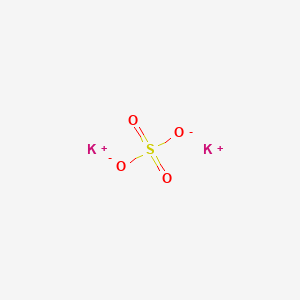
Formula: K₂SO₄ — Sulfate of potash, arcanite
Appearance: White crystalline solid
Hazard: Irritant
Properties
White crystalline solid, moderately soluble in water. An important potassium fertilizer providing both potassium and sulfur. Solutions are nearly neutral. Forms orthorhombic crystals. Related to potassium chloride and other potassium salts - the violet flame test color is identical across all potassium compounds, regardless of the anion.
Historical Context
Potassium sulfate has been known since the 14th century, when the alchemist Pseudo-Geber described its preparation by combining potassium carbonate with sulfuric acid. Early alchemists called it “vitriolated tartar.” Johann Rudolph Glauber produced it systematically in the 17th century by reacting potash with sulfuric acid.
Its importance grew with agriculture. As chemists in the 19th century worked out which elements plants required, potassium was identified as essential for fruit and flower development. Potassium sulfate became preferred over potassium chloride for chloride-sensitive crops like tobacco, grapes, and many fruits, since the sulfate anion provides sulfur (a secondary nutrient) without the potentially damaging chloride.
The compound is also valued in flame spectroscopy as a calibration standard: because all potassium compounds give identical violet flame colors, potassium sulfate provides a convenient, non-deliquescent (not moisture-absorbing) source of K⁺ for testing.
Experiments
Flame Tests: Produces a characteristic violet/lilac flame color from the potassium ion. Compare directly with potassium chloride - the colors are identical, proving that flame color depends only on the metal, not the anion. Also compare with sodium (yellow) and copper (blue-green).
Crystal Growing: Grow orthorhombic crystals by dissolving in hot water until saturated, then slowly cooling or evaporating. The crystal shape differs from cubic NaCl, demonstrating how different compounds form different crystal systems.
Fertilizer Science: Use in plant growth experiments as a chloride-free potassium source. Compare plant response to potassium sulfate vs. potassium chloride, or test with plants known to be chloride-sensitive.
Experiments using this chemical:
- Flame Tests - Violet/lilac flame color, proving anion doesn’t matter
Safety
Low hazard — fertiliser salt.
Incompatible with: Reactive metals under alkaline conditions; aluminium fluoride (violent reaction at high temperature); strong reducing agents