Silver Nitrate
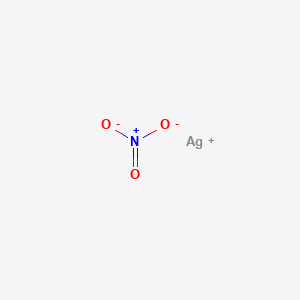
Formula: AgNO₃ — Lunar caustic, silver(I) nitrate
Molar mass: 169.87 g/mol
Appearance: Colorless to white crystalline solid (darkens in light)
Hazard: Corrosive · Oxidiser · Toxic · Environmental hazard
Summary
Colorless to white crystalline solid, very soluble in water. Light-sensitive - solutions and crystals darken when exposed to light due to reduction to silver metal. Strong oxidizer. The silver ion forms insoluble precipitates with halides (chloride, bromide, iodide). Foundation of photography chemistry. Used in medicine, mirror-making, and analytical chemistry.
History
The name “lunar caustic” reflects the alchemical association of silver with the Moon. Medieval physicians used silver nitrate sticks to cauterize wounds and remove warts - a practice that continued into the 20th century.
Silver nitrate’s light sensitivity became the foundation of photography. In 1727, Johann Heinrich Schulze discovered that silver salts darkened in sunlight. Thomas Wedgwood and Humphry Davy1 created the first photographs (photograms) using silver nitrate around 1800, though they couldn’t fix the images. Louis Daguerre’s famous process (1839) and Fox Talbot’s calotype both relied on silver halide light sensitivity.
The Tollens’ test, developed by Bernhard Tollens2 in 1881, uses silver nitrate to detect aldehydes by depositing a silver mirror on glass. This same reaction produces decorative mirrors - a technology that replaced the toxic mercury amalgam process.
Experiments
Silver Mirror Reaction (Tollens’ Test): Make Tollens’ reagent (silver-ammonia complex) and reduce with glucose to deposit metallic silver on glass, creating a mirror. Demonstrates reduction of metal ions and is a classic test for aldehydes. Beautiful results but requires careful preparation.
Halide Precipitation: Add to solutions containing chloride, bromide, or iodide to form characteristic precipitates - AgCl (white), AgBr (cream), AgI (yellow). Classic qualitative analysis for halides. The precipitates are light-sensitive and darken over time.
Photography Chemistry: Silver halide light sensitivity is the basis of traditional photography. Expose silver chloride paper to light through a negative to see image formation. Demonstrates photochemistry and redox reactions.
Experiments using this chemical:
- Crystal Growing - Light-sensitive crystals (advanced)
- Silver Mirror Reaction - Tollens’ test, coat glass with silver
- Halide Precipitation - Colored precipitates with halides
Safety
Significant hazard — corrosive oxidiser; permanent black staining.
First aid: rinse skin and eyes with plenty of water — skin contact leaves harmless black stains that wear off over days. Seek medical care for eye contact. If swallowed, drink water and get medical help.
Incompatible with: All organic materials (potential fire — strong oxidiser); alcohols, acetone, glycerol (oxidiser-fuel hazard); reducing agents; ammonia in excess (explosive silver nitride under some conditions); acetylene and terminal alkynes (shock-sensitive silver acetylide); alkalis; reactive metals (rapid reduction to silver)
Disposal: precipitate the silver as insoluble silver chloride by adding table salt, let it settle, filter or decant, and bin the solid; the clear liquid can then be flushed. Do not pour silver solutions down the drain.
Footnotes
Humphry Davy — British chemist (1778–1829) who used electrolysis to isolate sodium, potassium, and other elements.↩︎
Bernhard Tollens — German chemist (1841–1918) whose silver-mirror reagent tests for aldehydes.↩︎