Sodium Acetate
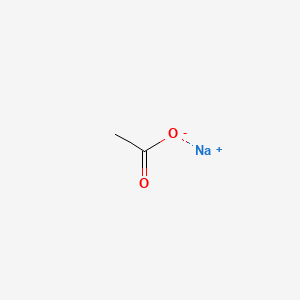
Formula: CH₃COONa·3H₂O — Sodium acetate trihydrate, hot ice
Appearance: Colorless crystalline solid
Hazard: Not classified as hazardous
Properties
Colorless crystalline solid with a slightly salty, vinegar-like taste. Highly soluble in water with an unusual property: solutions can be easily supersaturated, remaining liquid well below the normal crystallization temperature. When triggered, the supersaturated solution crystallizes instantly and exothermically, releasing heat. Used in hand warmers, food preservation (E262), and as a buffer. The acetate ion is the conjugate base of acetic acid (vinegar).
Historical Context
Sodium acetate’s dramatic supersaturation behavior has fascinated scientists since the 19th century. The phenomenon was described in detail by Gay-Lussac and others studying crystallization. The ability of a liquid to remain liquid below its freezing point, then suddenly solidify when triggered, seemed almost magical.
The compound itself has an ancient lineage - it forms when vinegar reacts with washing soda, a reaction known since antiquity. Medieval dyers used impure sodium acetate as a mordant. The pure compound was first isolated and characterized in the early 1800s.
Commercial exploitation came with the development of reusable hand warmers in the 1970s. A small metal disc, when clicked, creates local stress that nucleates crystallization. The entire supersaturated solution solidifies within seconds, releasing its heat of crystallization (about 264 kJ/kg). Boiling the pack redissolves the crystals for another use - a perfect demonstration of reversible physical change.
The nickname “hot ice” comes from the way the crystallizing solution resembles freezing water, yet releases heat rather than absorbing it.
Preparation
Sodium acetate is easily made at home: add baking soda (sodium bicarbonate) to white vinegar (acetic acid) a little at a time until fizzing stops. Evaporate the resulting solution on low heat until a dry white solid remains — this is sodium acetate. For the supersaturating “hot ice” effect, the solution must be concentrated without allowing it to boil dry; stop heating when a thick syrup forms, transfer to a clean jar, and let cool undisturbed. The anhydrous form used in hand warmers can be made by heating the trihydrate crystals above 58°C until they melt and lose their water of crystallization, then cooling carefully.
Experiments
Hot Ice / Instant Crystallization: Create a supersaturated solution by dissolving excess sodium acetate in hot water. When cooled and triggered with a seed crystal, the entire solution crystallizes instantly into a solid mass, releasing significant heat. The crystallization can be “poured” to create towers and sculptures. Reusable - just reheat to dissolve and repeat. Video demonstration
Reusable Hand Warmer: Commercial hand warmers use supersaturated sodium acetate. Clicking a metal disc inside provides a nucleation point, triggering crystallization and releasing heat (up to 54°C). Boiling the pack redissolves the crystals for reuse.
Homemade Preparation: Can be made by neutralizing baking soda with vinegar: CH₃COOH + NaHCO₃ → CH₃COONa + H₂O + CO₂. Boil off excess water to concentrate. DIY guide
Experiments using this chemical:
- Instant Ice Crystallization - Supersaturation and nucleation
- Food Chemistry - Supersaturation demonstrations
Safety
Very low hazard — food-safe.
Incompatible with: Strong oxidisers; strong acids (releases acetic acid — vinegar smell); fluorine