Sodium Carbonate
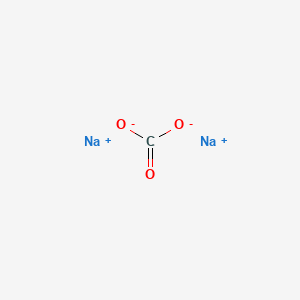
Formula: Na₂CO₃ — Soda ash, washing soda
Molar mass: 105.99 (anhydrous) g/mol
Appearance: White powder or crystalline solid
Hazard: Irritant
Summary
White powder or crystalline solid, moderately alkaline (pH ~11.5). Made industrially by the Solvay process or from natural deposits. Decomposes acids releasing CO₂. Used in glassmaking, detergents, and water treatment. Related to sodium bicarbonate - heating baking soda produces sodium carbonate. Can be converted back to bicarbonate by bubbling CO₂ through solution.
History
Sodium carbonate has been vital to civilization for millennia. The ancient Egyptians mined natural deposits of natron (a mixture of sodium carbonate and bicarbonate) from dried lake beds. They used it for mummification, glass-making, and as an early form of soap when mixed with fats.
For centuries, Europe obtained soda ash by burning seaweed or certain coastal plants (barilla), an expensive and environmentally destructive process. The Leblanc1 process, developed in 1791, used salt, sulfuric acid, coal, and limestone to produce soda ash - the first large-scale industrial chemical process.
In 1861, Ernest Solvay2 patented a more efficient process that remains in use today. The Solvay process bubbles ammonia and carbon dioxide through brine to precipitate sodium bicarbonate, which is then heated to produce soda ash. This elegant chemistry made sodium carbonate cheap and abundant, enabling the modern glass and detergent industries.
Experiments
Water Softening: Demonstrate how sodium carbonate precipitates calcium and magnesium from hard water, making soap work better. Add to hard water with soap and compare suds formation vs. untreated hard water.
pH Buffer: Create basic buffer solutions and test pH changes when adding small amounts of acid. Shows buffer capacity and the carbonate buffering system. Can also demonstrate CO₂ release when acidified, forming sodium bicarbonate then carbonic acid.
Experiments using this chemical:
- Rainbow pH Indicator - Yellow color at high pH
- Water Softening - Precipitates hard water minerals
How to get it
Sodium carbonate (washing soda) is sold in the laundry aisle as Arm & Hammer Super Washing Soda. This is anhydrous sodium carbonate — exactly what’s needed for most experiments. Do not confuse it with baking soda (sodium bicarbonate, NaHCO₃) or soda ash — though “soda ash” and anhydrous sodium carbonate are the same thing.
Pool supply: Available as “pH Up” or alkalinity increaser. Typically 100% sodium carbonate and cheaper in larger quantities.
Making it yourself
Sodium carbonate is easily made by heating baking soda (sodium bicarbonate) in an oven at 200–250°C for about an hour. The bicarbonate loses carbon dioxide and water: 2NaHCO₃ → Na₂CO₃ + H₂O + CO₂. The resulting powder is noticeably more alkaline than the original baking soda — a drop of red cabbage indicator will show the difference immediately. The product is anhydrous sodium carbonate (soda ash), identical to the washing soda sold for laundry use, though washing soda sold in stores is the decahydrate (Na₂CO₃·10H₂O), which absorbs moisture from the air over time.
Buy online:
Amazon: Reagent-Grade Sodium Carbonate Anhydrous, 500g — The Curated Chemical Collection affiliate
Safety
Moderate hazard — strongly alkaline; irritant.
First aid: flush skin and eyes with plenty of water and seek medical care for eye contact. If swallowed, rinse the mouth and drink water.
Incompatible with: Strong acids (vigorous CO₂ release); aluminium and magnesium (CO₂ evolution in aqueous solution); fluorine; phosphorus pentoxide
Disposal: neutralize with dilute acid or vinegar if concentrated, then dilute and flush down the drain (washing soda is itself a common drain cleaner).
Footnotes
Nicolas Leblanc — French chemist (1742–1806) who devised the first industrial process for making soda ash.↩︎
Ernest Solvay — Belgian chemist (1838–1922) whose ammonia-soda process replaced the Leblanc process for soda ash.↩︎