Sodium Hydroxide
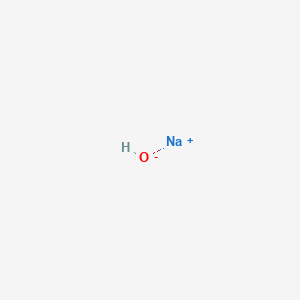
Formula: NaOH — Lye, caustic soda
Molar mass: 40.00 g/mol
Appearance: White pellets or flakes; highly hygroscopic
Hazard: Corrosive · Severe burns · Strong base
Summary
Strong base that fully dissociates in water, releasing Na⁺ and OH⁻ ions. Dissolution is strongly exothermic (~44 kJ/mol — the solution heats noticeably). Absorbs both moisture and CO₂ from air, gradually converting to sodium carbonate; store in sealed containers. Saponifies fats and oils (soap making). Precipitates most metal hydroxides when added to their salt solutions: blue Cu(OH)₂, green Fe(OH)₂, red-brown Fe(OH)₃. A 10 g solution in 100 mL water reaches approximately pH 13.
History
Sodium hydroxide’s story is inseparable from soap. For millennia, people made lye by leaching wood ash (potassium carbonate, K₂CO₃) through water, then boiling the caustic liquid with animal fat. The triglyceride fat molecules are hydrolyzed to glycerol and fatty acid salts — soap. Pure sodium hydroxide was not isolated until Humphry Davy1 electrolyzed molten NaOH in 1807, obtaining metallic sodium.
Industrial production came first from causticizing soda ash with slaked lime (Na₂CO₃ + Ca(OH)₂ → 2 NaOH + CaCO₃), and later from the chlor-alkali process, which electrolyzes brine (NaCl solution) and co-produces NaOH and chlorine. The chlor-alkali industry is still one of the world’s largest chemical processes — NaOH is essential to paper making (wood pulp digestion), textile manufacture, water treatment, oil refining, and food processing.
In food, sodium hydroxide (food-grade lye) is used to cure olives (removing bitter glucosides), make Chinese century eggs, give pretzels and bagels their characteristic dark, glossy crust (lye treatment enables fast Maillard2 browning at baking temperature), and process cocoa (Dutch-process chocolate).
Experiments
Blue Bottle Reaction: Dissolve glucose, methylene blue indicator, and NaOH in water. Shake to turn blue, then let stand to decolorize — a reversible redox cycle driven by dissolved oxygen. The alkaline medium is essential for enabling glucose to reduce the indicator.
Traffic Light Reaction: NaOH dissolved with glucose and indigo carmine indicator cycles through three colors (green → yellow → red) as glucose reduces the dye in stages, with shaking to re-oxidize.
Metal Hydroxide Precipitation: Add dilute NaOH solution to copper sulfate (blue Cu(OH)₂ precipitate), ferrous sulfate (green Fe(OH)₂), or ferric chloride (red-brown Fe(OH)₃). Each produces a distinctively colored precipitate — the same colors explored in The Many Colors of Iron. (These are simple metal hydroxides — not Prussian blue, which needs a hexacyanoferrate source.)
Experiments using this chemical:
- Blue Bottle Reaction — Alkaline medium for reversible methylene blue redox
- Traffic Light Reaction — Alkaline medium for multi-color redox cycling
- Indigo Vat Dyeing — Alkaline reducing vat
- The Many Colors of Iron — Precipitation of colored metal hydroxides
- Making Sodium Metal Without Electrolysis — Reduced by magnesium to elemental sodium (advanced)
How to get it
Sodium hydroxide (lye) is available from several sources:
- Soap making suppliers: the most common source online; sold as food-grade lye (NaOH) in 1–2 lb bags of white flakes or pellets. Essential for saponification and widely available.
- Drain cleaners: products like Red Devil Lye (now hard to find) or pure NaOH drain cleaners exist, but verify the product is 100% NaOH — many contain additives. Check the label carefully.
- Online: search “sodium hydroxide food grade lye” for reliable lab-quality product.
Store in a tightly sealed container — it absorbs moisture and CO₂ from air, gradually converting to sodium carbonate.
Buy online:
Amazon: Sodium Hydroxide Lye for Soap Making — Pure Food Grade, 2 lbs affiliate
Safety
High hazard — severely corrosive; causes immediate tissue damage on contact.
Wear gloves and eye protection at all times. Dissolve pellets slowly with stirring — the solution heats significantly and can splash. Never seal a hot solution.
First aid: skin or eye contact — flush immediately with large amounts of running water for at least 15 minutes; for eyes, or any significant burn, seek medical attention while flushing. Do not try to neutralize a burn on skin with acid — keep rinsing with water. If swallowed, do not induce vomiting; rinse the mouth, drink water, and get medical help.
Incompatible with: Strong acids (very exothermic neutralisation); aluminium, zinc, and tin (hydrogen gas evolved — reaction can be vigorous); ammonium salts (releases ammonia gas on heating); moisture in containers (heat and potential spattering if added carelessly); high concentrations around organic materials (risk of charring)
Disposal: neutralize spills and spent solutions with dilute acid or plenty of vinegar to near-neutral pH, then flush down the drain with lots of water. Keep solid lye sealed for reuse rather than discarding.
Footnotes
Humphry Davy — British chemist (1778–1829) who used electrolysis to isolate sodium, potassium, and other elements.↩︎
Louis-Camille Maillard — French chemist (1878–1936) who described the browning reaction between sugars and amino acids.↩︎