Sodium Iodide
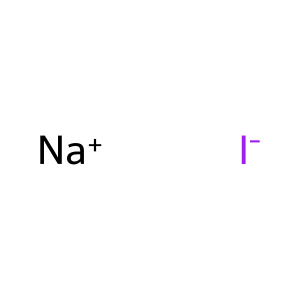
Formula: NaI — Sodium iodide
Molar mass: 149.89 g/mol
Appearance: White crystalline solid (may yellow slightly on aging due to trace iodine)
Hazard: Low hazard
Summary
White crystalline solid, extremely soluble in water (184g/100mL at 25°C — one of the most soluble common salts). Hygroscopic — absorbs moisture from air readily. Solutions are colorless and neutral. On prolonged exposure to air and light, iodide is slowly oxidized to iodine, causing a yellow-brown discoloration; adding a trace of sodium thiosulfate as a stabilizer prevents this. Closely related to potassium iodide (KI), which is more commonly used in lab settings, but NaI is a fine substitute.
History
Iodide salts gained importance in the 19th century when iodine was discovered in seaweed ash (1811, Bernard Courtois) and its role in preventing goiter became understood. Sodium and potassium iodide were added to table salt starting in the 1920s as a public health measure — iodized salt virtually eliminated endemic goiter in much of the world, one of the most successful nutritional interventions in history.
In photography, silver iodide was used alongside silver bromide in early photographic emulsions. In organic chemistry, the Finkelstein reaction uses sodium iodide in acetone to convert alkyl chlorides and bromides to the more reactive iodides — NaI is ideal because NaCl and NaBr are insoluble in acetone and precipitate out, driving the equilibrium forward.
Experiments
Iodine Synthesis: Dissolve NaI in water, acidify with a few drops of dilute hydrochloric acid, then add hydrogen peroxide. Iodide ions are oxidized to elemental iodine — the solution turns orange-brown immediately. Adding starch solution gives the intense blue-black starch-iodine complex, confirming iodine production. Clean, fast, and visually striking.
Starch-Iodine Test: Make a dilute NaI solution, oxidize a small portion to iodine with H₂O₂, then use it as a reagent to test household items for starch (bread, potato, rice water). The blue-black color indicates starch; no color change means starch is absent.
Halide Precipitation: React NaI solution with silver nitrate — a bright yellow precipitate of silver iodide (AgI) forms immediately. Compare side-by-side with sodium chloride (white AgCl) and sodium bromide (cream AgBr) to see the halide series. Leave the precipitates in light to observe photodarkening.
Experiments using this chemical:
- Iodine from Sodium Iodide — Oxidise iodide to iodine with HCl and H₂O₂
- Halide Precipitation Tests — Bright yellow AgI precipitate
Safety
Low hazard — handle with normal care.
Iodide solutions are mild irritants in quantity. Iodine produced from NaI during experiments will stain skin and clothing brown — wear gloves when handling iodine-containing solutions. Store in a sealed container away from light to prevent slow oxidation and yellowing.
First aid: rinse skin and eyes with water; iodine liberated during experiments stains skin brown (fades). If swallowed, rinse the mouth and drink water.
Incompatible with: Oxidizing acids (HNO₃, concentrated H₂SO₄) — release iodine and iodine vapour; strong oxidizers (chlorine, bromine, permanganate) — rapid iodine liberation; silver nitrate — immediate yellow AgI precipitate
Disposal: dilute and flush down the drain; reduce any liberated iodine with a little vitamin C first.