Sodium Silicate
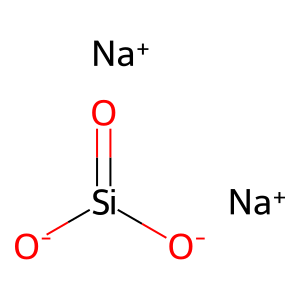
Formula: Na₂SiO₃ (and related ratios) — Sodium metasilicate, “water glass”
Molar mass: 122.06 g/mol (metasilicate)
Appearance: Colourless-to-pale syrupy liquid, or white solid
Hazard: Corrosive · Irritant
Summary
An alkaline solution of sodium and silicate ions, sold as a thick, glassy syrup called water glass. Its silicate ions react with dissolved metal salts to build coloured, semipermeable membranes — the basis of the “chemical garden.” It is also used to seal concrete, preserve eggs, and as an adhesive. The solution is strongly basic and corrosive.
History
Water glass has been made since the 17th century and was studied in depth by Johann Nepomuk von Fuchs in the 1820s. The dramatic mineral “gardens” that grow when metal salts are dropped into it have fascinated chemists since at least the 1600s, and were once thought to mimic living growth — an early puzzle in what we now call self-organising chemistry.
Experiments
Chemical garden: Silicate ions react with metal-salt crystals to form insoluble, coloured metal-silicate membranes. Osmosis then drives water inward, bursting and re-sealing the membrane so it grows upward into plant-like fronds.
Experiments using this chemical:
- Chemical Garden - Silicate source for the growing membranes
Safety
Moderate hazard — strongly alkaline and corrosive to skin and eyes.
First aid: rinse skin and especially eyes with plenty of water for several minutes; seek medical advice for eye contact.
Incompatible with: Acids (gels/precipitates silica, exothermic); aluminium and other amphoteric metals.
Disposal: neutralise dilute solutions with vinegar, then flush with plenty of water; bin any silica gel.