Sodium Sulfate
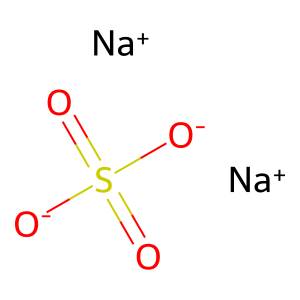
Formula: Na₂SO₄ (anhydrous) · Na₂SO₄·10H₂O (Glauber’s salt)
Molar mass: 142.04 (anhydrous); 322.20 (decahydrate) g/mol
Appearance: White crystalline solid (anhydrous); large colorless monoclinic crystals (decahydrate)
Hazard: Not classified as hazardous
Summary
The anhydrous form (thenardite) is a white powder that absorbs atmospheric moisture rapidly, converting to the decahydrate (Glauber’s salt). The decahydrate forms large, clear monoclinic crystals that are stable below 32.4°C but effloresce (lose water) slowly in dry air.
Solubility is unusual: it rises steeply with temperature up to 32.4°C, then decreases above this point — one of the few common salts to show this retrograde behaviour. At 32.4°C the decahydrate melts congruently in its own water of crystallisation (about 44 g per 100 g of water), making it a natural phase change material. On cooling below 32.4°C it tends to supercool significantly, remaining liquid well below its crystallisation point — analogous to the sodium acetate “hot ice” effect, but at a gentler temperature.
History
Johann Rudolf Glauber1 (1604–1670), a Dutch-German chemist and alchemist, isolated the decahydrate from spring water and named it sal mirabile Glauberi — Glauber’s wonderful salt. He promoted it as a universal medicine and laxative and made a good living selling it. The compound genuinely works as a mild osmotic laxative, a use that persisted in pharmacopoeia until the 20th century.
The large-scale industrial importance of sodium sulfate came much later. In the kraft paper process, sodium sulfate is added to the “black liquor” (spent pulping chemical), where it is reduced to sodium sulfide, which is then recycled back into the digestion process. This cycle makes kraft pulping efficient enough to produce the majority of the world’s paper. The detergent industry uses it as a filler and carrier in powder formulations.
More recently, sodium sulfate decahydrate has attracted interest as a phase change material (PCM) for thermal energy storage — its melting point of 32.4°C and high latent heat (~254 kJ/kg) make it suitable for solar thermal storage and building temperature regulation.
How to get it
Anhydrous sodium sulfate is sold as a laboratory reagent and as a laundry aid under the trade name Sal de Vichy in some regions. Glauber’s salt (the decahydrate) can be made by dissolving anhydrous sodium sulfate in warm water and allowing it to recrystallise below 32°C, or purchased as a pharmacy laxative. Both forms work for the experiments below.
Experiments
Retrograde Solubility Demonstration: Prepare a saturated solution at 25°C (about 28 g per 100 mL). Warm gently while observing — if you started with excess solid it will dissolve completely well below 40°C. Now allow to cool; as temperature drops below 32.4°C, crystals begin to form spontaneously. The reversal — dissolving faster as you heat up, then crashing out as it cools — illustrates that solubility is not always monotonic.
Glauber’s Salt Supersaturation: Dissolve 70 g of anhydrous sodium sulfate in 100 mL warm water (≥35°C). Filter into a very clean jar, seal, and allow to cool without disturbing. Below 32.4°C the solution is supersaturated — it holds more dissolved salt than equilibrium allows. Drop in a seed crystal to trigger rapid crystallisation, accompanied by a small but measurable warming as latent heat is released. Reheat to redissolve; repeat indefinitely.
Thermal Energy Storage: Fill a small sealed container with Glauber’s salt and warm it above 32.4°C (a hot water bath works well) until fully melted. Remove and wrap in insulating material. Measure the temperature every few minutes as it cools. The temperature will plateau near 32.4°C for an extended period — this flat region is the latent heat being released as the salt re-crystallises, storing and then releasing energy at a fixed temperature.
Experiments using this chemical:
- Glauber’s Salt — Thermal Energy Storage — Retrograde solubility, supersaturation, and phase change
Safety
Not classified as hazardous. Safe to handle without special precautions.
Mild osmotic laxative if ingested in significant quantity (used medicinally). Avoid raising dust from the anhydrous form. The decahydrate is stable and non-irritating.
First aid: none needed; rinse eyes with water if dust gets in them.
Incompatible with: No significant laboratory incompatibilities; in concentrated form can react with barium salts to precipitate barium sulfate
Disposal: harmless — dilute and flush down the drain, or bin the solid.
Footnotes
Johann Rudolf Glauber — German-Dutch chemist (1604–1670) who first made sodium sulfate (‘Glauber’s salt’) and potassium permanganate.↩︎