Sodium Thiosulfate
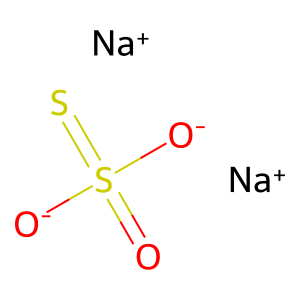
Formula: Na₂S₂O₃·5H₂O — Sodium thiosulfate pentahydrate, “hypo”
Molar mass: 248.18 (pentahydrate) g/mol
Appearance: Colourless crystalline solid
Hazard: Low hazard
Summary
Colourless, water-soluble solid famous as photographic “hypo” — the fixer that dissolves unexposed silver halides so a developed image no longer darkens in light. It is also a common dechlorinator (it reduces chlorine to chloride) and a mild reducing agent used in iodine titrations1.
History
Sodium thiosulfate’s fixing action was discovered by John Herschel2 in 1819, decades before photography existed. When Herschel shared it with the early photographers of the 1830s–40s, “hypo” (from the old name hyposulphite of soda) became the universal fixer that made permanent photographs possible — the step that stops a print from fogging once it meets daylight.
Experiments
Photographic fixing: Dissolves the silver halides that light never reduced, leaving only the metallic-silver image behind — the last wet step in caffenol and other darkroom processes.
Experiments using this chemical:
- Caffenol Film Development - Fixer that clears unexposed silver halide
Safety
Low hazard — used medically (antidote to cyanide poisoning) and in aquariums.
First aid: none usually needed; rinse eyes with water.
Incompatible with: Strong acids (releases sulfur dioxide and sulfur); strong oxidisers.
Disposal: small quantities can be flushed with plenty of water.
Footnotes
Titration — Measuring an unknown concentration by adding a reagent of known concentration until the reaction just completes.↩︎
John Herschel — English polymath (1792–1871) who invented the cyanotype photographic process in 1842.↩︎