Tannic Acid
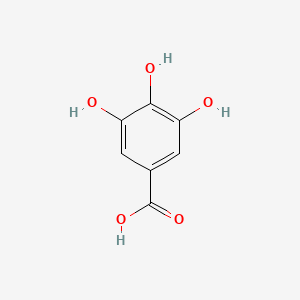
Formula: C₇₆H₅₂O₄₆ — Tannin, gallotannin, tannic acid
Molar mass: 1701.2 g/mol
Appearance: Yellow-brown amorphous powder
Hazard: Irritant
Summary
Yellow-brown amorphous powder, soluble in water and ethanol. A polyphenol - a large molecule built from gallic acid units attached to a glucose core. Found in tea, oak bark, grape skins, and many other plants. Responsible for the astringent taste of tea and red wine. Reacts with iron(III) ions to form an intensely black complex. Precipitates proteins and alkaloids.
History
Tannins take their name from the ancient art of tanning leather. Oak bark, rich in tannins, was used to cure animal hides into leather for thousands of years - the tannin molecules cross-link the collagen proteins in skin, making them resistant to decomposition and water. Roman tanneries were a fixture of every city.
The most chemically famous application of tannins is iron gall ink, the dominant writing ink of Western civilization for over a millennium. The Magna Carta (1215), Leonardo da Vinci’s notebooks, Bach’s musical manuscripts, and the US Declaration of Independence were all written with iron gall ink - a mixture of tannin and iron sulfate. The chemistry was understood only in the 19th century, when researchers showed that Fe²⁺ from iron sulfate chelates the tannin polyphenols, and that air oxidizes the initial blue-gray complex to the permanent black Fe³⁺-tannate.
Tannins also serve as mordants in natural dyeing. Applied to fabric before the dye bath, they bind to both the fiber and the dye molecules, giving much richer, more permanent color. This function was essential to the textile industry for centuries.
How to get it
A concentrated tannin solution suitable for experiments is easily extracted from tea or oak galls. For tea: steep 5–10 black tea bags in 200 mL of near-boiling water for 20–30 minutes; the resulting dark brown liquid contains roughly 2–4% tannic acid and can be used directly for iron gall ink without further processing. For a stronger extract, simmer chopped oak galls (available from natural dye suppliers) in water for 30 minutes, then filter — this yields a higher tannin concentration closer to the commercial powder. Pure tannic acid powder extracted by solvent methods is an industrial product, but these aqueous extracts work well for all the experiments described here.
Experiments
Iron Gall Ink: Mix tannic acid solution with ferrous sulfate to produce the classic blue-black ink. The tannins complex with Fe²⁺ initially (blue-gray), then oxidize to the permanent black Fe³⁺ tannate. Historically used for important documents.
Protein Precipitation: Add tannic acid to egg white solution - the tannins bind and precipitate proteins, demonstrating astringency at a molecular level. This is why strong tea makes your mouth feel dry.
Natural Dye Mordant: Use as a mordant before dyeing fabric with natural dyes. The tannins bind to fabric fibers and grip the dye molecules, giving much richer, longer-lasting color.
Experiments using this chemical:
- Iron Gall Ink - Classic iron-tannin ink
- The Many Colors of Iron - Iron gall ink forming as part of the iron color tour
Safety
Low-moderate hazard — protein precipitant; stains.
First aid: rinse skin and eyes with water; if swallowed, rinse the mouth and drink water.
Incompatible with: Iron and iron(II) salts (forms insoluble blue-black iron tannate — the intended iron gall ink reaction); gelatins and protein-based materials (precipitation); strong oxidisers; alkaloids (precipitation)
Disposal: biodegradable — dilute and flush small amounts down the drain (it stains, so run plenty of water).