Glycerin
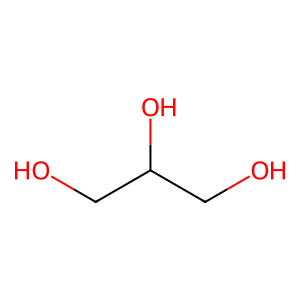
Formula: C₃H₈O₃ — Glycerol (propane-1,2,3-triol)
Molar mass: 92.09 g/mol
Appearance: Clear, colorless, odorless, syrupy liquid; sweet taste
Hazard: Very low hazard · Food-safe · Flammable when heated
Summary
Glycerin (glycerol) is a clear, thick, sweet liquid — a triol, with a hydroxyl (–OH) group on each of its three carbons. Those three –OH groups make it intensely hygroscopic: it pulls water from the air, which is why it works as a humectant in soaps, foods, and cosmetics, keeping them moist. It mixes with water and alcohol in all proportions but not with oils.
Its refractive index (≈ 1.47) is very close to that of Pyrex/borosilicate glass, so glass objects submerged in glycerin nearly vanish. It has a high boiling point (290 °C) and low toxicity, and is a by-product of every soap-making reaction — saponifying a fat releases glycerol as the fatty acids are pulled off its backbone.
History
Glycerol was discovered in 1779 by Carl Wilhelm Scheele1, who heated olive oil with litharge and found a sweet liquid — he called it the “sweet principle of fats.” Its structure as the three-armed backbone of all fats and oils (triglycerides) was worked out by Michel-Eugène Chevreul in the early 1800s, founding the chemistry of fats.
In 1847 Ascanio Sobrero nitrated it to make nitroglycerin, a dangerously unstable explosive; Alfred Nobel later tamed it as dynamite, building the fortune behind the Nobel Prizes. Today glycerin is produced on an industrial scale, both from fats and as the major by-product of biodiesel manufacture, and is ubiquitous in food, medicine, and cosmetics.
How to get it
Sold cheaply and food-grade (“vegetable glycerin”/glycerol, USP) in pharmacies, baking aisles, and soap-making suppliers. It is also the glycerol left over whenever a fat is saponified into soap. Buy the pure product rather than glycerin suppositories or skin products that contain other ingredients.
Experiments
Vanishing glass (refractive-index matching): Submerge a Pyrex rod or beaker in glycerin and it becomes nearly invisible, because glass and glycerin bend light almost identically. A vivid demonstration of what refractive index actually means.
Long-lasting bubbles & humectant demos: A little glycerin in soap solution slows evaporation and makes far stronger, longer-lived bubbles — the same water-holding trick used to keep icing and crystals from drying out.
Slime plasticizer: Added to borax or PVA slime, glycerin makes it softer and stretchier by lubricating between polymer chains.
Oxidation to fire (demonstration): A drop of glycerin on a small pile of potassium permanganate ignites on its own after a short delay as the permanganate oxidizes the glycerol — a striking self-starting fire that must be done outdoors on a fireproof surface, in tiny amounts, by an adult.
Experiments using this chemical:
- Vanishing Glass: Refractive-Index Matching - Why glass disappears in glycerin
- Soap Making (Saponification) - Glycerol is released from the fat
- Slime - Glycerin as a softening plasticizer
Safety
Glycerin is food-safe, non-toxic, and gentle on skin — one of the safest chemicals in the lab. It is only a mild laxative if drunk in quantity.
First aid: none needed — glycerin is gentle on skin; rinse eyes with water if needed.
Incompatible with: Strong oxidizers — potassium permanganate, concentrated nitric acid, chlorates — which react violently and can ignite it. Keep it away from open oxidizer piles unless deliberately running a supervised demonstration.
Disposal: biodegradable and harmless — flush small amounts down the drain with water.
Footnotes
Carl Wilhelm Scheele — Swedish-German chemist (1742–1786) who discovered oxygen, chlorine, and many acids, often uncredited.↩︎