Sodium Metabisulfite
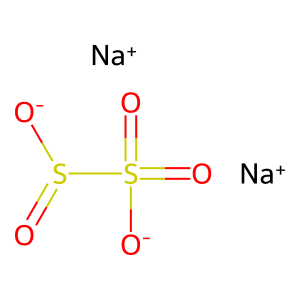
Formula: Na₂S₂O₅ — Sodium metabisulfite (sodium pyrosulfite)
Molar mass: 190.11 g/mol
Appearance: White crystalline powder with a faint sulfurous smell
Hazard: Irritant · Releases SO₂ gas · Allergen
Summary
Sodium metabisulfite is a white powder that is best understood as dry, storable sulfur dioxide. Dissolved in water it forms bisulfite (HSO₃⁻); add acid and it releases pungent SO₂ gas:
\[\ce{Na2S2O5 + 2 H+ -> 2 SO2 ^ + H2O + 2 Na+}\]
That sulfur dioxide is a mild reducing agent and bleach. It mops up oxygen and chlorine, decolorizes many dyes, and inhibits the enzymes and microbes that spoil food — which is why it appears on wine, dried-fruit, and juice labels as preservatives E223/E224. The same chemistry makes it a standard dechlorinator for tap water and a preservative in photographic developers.
History
Burning sulfur to preserve food and fumigate is ancient — Homer mentions it, and Roman winemakers sulfured their casks. Sulfur dioxide has protected wine from oxidation and spoilage for two thousand years; sodium metabisulfite is simply the modern, convenient way to deliver a measured dose of it without a sulfur candle. In photography, sulfite salts became essential around the late 19th century as preservatives that keep developing agents from being oxidized by air, greatly extending the working life of a developer.
How to get it
Sold cheaply and in food or “Campden tablet” grade by home-brewing and winemaking suppliers (for sterilizing equipment), by dried-fruit and canning suppliers, and by photographic chemical vendors. Campden tablets are pre-measured sodium (or potassium) metabisulfite. Store the powder dry and sealed — damp air slowly oxidizes it to sulfate and it loses potency.
Experiments
Sulfur dioxide bleaching: Dissolve a little metabisulfite, add acid to release SO₂, and hold a brightly colored flower petal or a dye-stained cloth in the fumes — the color fades as SO₂ reduces the dye. Some colors slowly return in air, showing the bleach is reductive, not destructive.
Dechlorinating water: A pinch instantly neutralizes the chlorine in tap water — useful before it is added to an aquarium or a sensitive reaction.
Antioxidant / anti-browning: A dilute dip stops cut apple or potato from going brown by disabling the browning enzymes, a direct comparison against ascorbic acid and lemon juice.
Reducing agent in the iodine clock: Bisulfite is the reductant in Landolt’s original iodine-clock reaction — it keeps the solution colorless until it is used up, triggering the sudden color change. (The accessible version on this site swaps in vitamin C for the same role.)
Experiments using this chemical:
- Sulfur Dioxide: Bleaching & Preserving - Reduction bleaching and antioxidant preservation of cut fruit
- Iodine Clock Reaction - Bisulfite is the reductant in the classic Landolt version
Safety
Releases sulfur dioxide, a sharp respiratory irritant — work in good ventilation and never mix the powder with acids in a closed space. SO₂ is a serious trigger for asthmatics and sulfite-allergic people; keep them clear of the fumes. Avoid skin and eye contact with concentrated solutions.
First aid: move to fresh air if SO₂ is inhaled — it can trigger asthma. Rinse skin and eyes with water. If swallowed, rinse the mouth and drink water; seek medical advice for sulfite-sensitive people.
Incompatible with: Acids (releases SO₂); strong oxidizers such as hydrogen peroxide, potassium permanganate, and bleach (vigorous, heat-releasing reaction).
Disposal: oxidize with dilute hydrogen peroxide (which converts it to harmless sulfate), then dilute and flush down the drain.